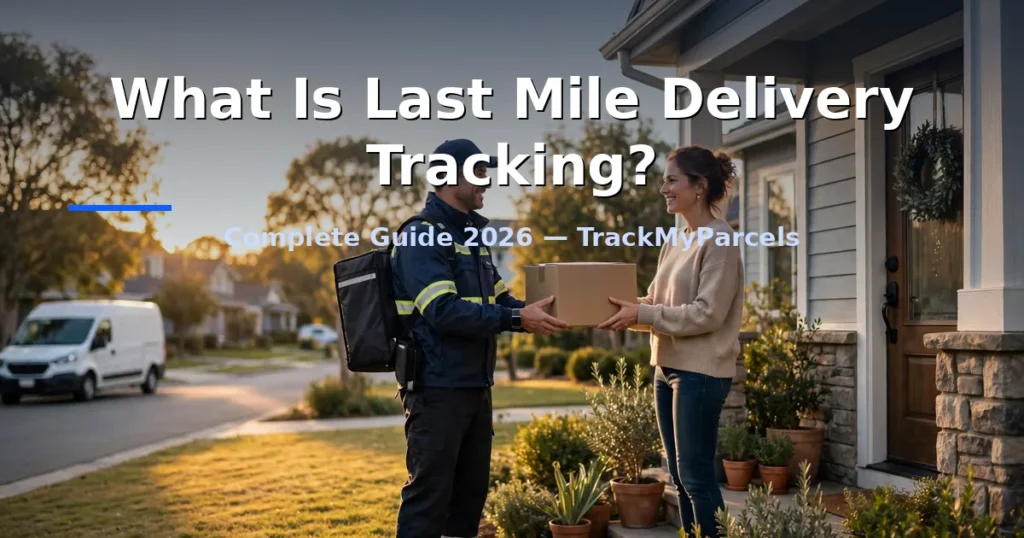
Last mile delivery tracking is how you follow your parcel on the final leg of its journey — from the local delivery depot to your doorstep. It is the part of tracking you actually watch: “out for delivery”, “arriving today”, “delivered”. This guide explains what the last mile means, how to track it, what each status means, and what to do when a parcel gets stuck.
In this guide:
- What Is Last Mile Delivery?
- Why the Last Mile Matters Most
- How to Track the Last Mile
- Common Last-Mile Statuses Explained
- What to Do If Your Parcel Is Stuck in the Last Mile
What Is Last Mile Delivery?
Last mile delivery is the final leg of a parcel’s journey — from the local distribution hub or delivery depot to your doorstep. A parcel may travel thousands of kilometres across countries and sorting centres, but the “last mile” is the short final trip, usually handled by a local driver in a van.
The name is slightly misleading: the last mile is rarely exactly one mile. It can be anything from a few streets to a full rural route. What defines it is the handoff point — your parcel leaves the carrier’s bulk network and enters local delivery. If you are new to how parcel networks work, start with our guide on what a courier service is.
Why the Last Mile Matters Most
The last mile gets the most attention in logistics for three reasons:
- It’s where delays happen. Missed delivery attempts, wrong addresses, gated buildings, and full vans all live in the last mile. Most “where is my parcel?” frustration starts here.
- It’s the most expensive leg. Industry analyses consistently rank the last mile as the costliest part of shipping — often more than half of the total delivery cost — because one driver delivers parcels one by one instead of in bulk.
- It’s the part you watch. Linehaul tracking (“departed sorting centre”) is abstract. Last-mile tracking (“out for delivery”, “arriving today”) is the part that tells you when to be home.
How to Track the Last Mile
You don’t need a special tool — last-mile tracking uses the same tracking number as the rest of the journey:
- Enter your tracking number on the courier’s tracking page (or our universal track page) exactly as printed on your receipt.
- Watch for the depot scan. “Arrived at delivery depot” or “at local facility” means your parcel has entered the last mile.
- “Out for delivery” is the key status. It means the parcel is on the van. Delivery is normally attempted the same day — see our guide on what out for delivery means.
- Turn on notifications. Most couriers offer SMS, email, or push alerts for the final statuses — far more useful here than at any earlier stage.
Some couriers show a live map or a delivery window once the parcel is out for delivery. If your courier offers it, use it — it’s the most precise last-mile signal available. You can find any carrier on our All Couriers page.
Common Last-Mile Statuses Explained
| Status | What it means |
|---|---|
| Arrived at delivery depot / local facility | Parcel reached your area’s hub; the last mile hasn’t started yet |
| Out for delivery | On the van — delivery attempted today |
| Delivery attempted | Driver came but couldn’t deliver (no answer, access issue) |
| Awaiting collection / at pickup point | Redirected to a locker, shop, or post office |
| Delivered | Handed over, left in a safe place, or collected |
Anything before the depot scan — “in transit”, “departed facility” — is still linehaul, not the last mile. See what “in transit” means for those earlier stages.
What to Do If Your Parcel Is Stuck in the Last Mile
- “Out for delivery” for more than a day: the van may have returned it to the depot. Check for a “delivery attempted” update or a missed-delivery card, then rebook or redirect via the courier’s page.
- Stuck at “arrived at depot” for 2+ days: contact the courier — the parcel may have missed its van sort. Find any carrier on our All Couriers page.
- Wrong address suspected: fix it through the courier’s delivery-preferences page before the next attempt; a second failed attempt often sends the parcel back.
- Safe-place or neighbour delivery: check the full tracking detail — couriers usually record exactly where they left it.
Frequently Asked Questions
What does last mile delivery mean?
The final step of delivery: moving your parcel from the local depot to your address. It’s called the “last mile” even though the actual distance varies.
How can I track last mile delivery?
Use your tracking number on the courier’s tracking page. The statuses to watch are “arrived at delivery depot” and “out for delivery” — they mark the start and the active phase of the last mile.
Why is last mile delivery so slow?
It’s not the distance — it’s the stops. One driver, dozens of addresses, traffic, failed attempts, and access problems. Rural routes and peak season (November–December) make it slower.
What is the difference between linehaul and last mile?
Linehaul moves parcels in bulk between hubs and cities. Last mile moves individual parcels from the local hub to doorsteps. Your tracking number covers both.
Does last mile tracking work for international parcels?
Yes. Once a cross-border parcel clears customs and reaches the destination country’s local depot, the destination carrier’s last-mile tracking takes over with the same tracking number.